 View of Seattle from the tugboat Crowley...
 Watching a container ship being loaded (or unloaded) by crane operators.
 A morning at the Port of Tacoma...
 Inter-modal transport...View of Seattle from the tugboat Crowley...Watching a container ship being loaded (or unloaded) by crane operators.A morning at the Port of Tacoma...Inter-modal transport...
 Walking through an old alleyway of Seattle. A wall of gum on our left, and a wall of art on our right.
  Okay, I left a bunch out, but I have algae waiting on me in the lab, but the history of Seattle is pretty interesting so I recommend reading up on it. I'll sign off with another great excerpt from Egan's The Good Rain:

 (it could fit in this "O")
 FIELDS OF CANE United States Sugar's Clewiston sugar cane refinery. A $1.75 billion deal to sell land and assets to Florida was reduced to 72,800 acres, in separate parcels, for $536 million.
  I just returned from the Pacific Northwest field seminar! Pictures and details coming soon...

 Fast forward to 1992 when activists within the Pequot nation demand the statue be removed and destroyed claiming it represented the genocide of their people by John Mason. The citizens of Mystic protested the proposal since the monument commemorated part of their founding history. As Leigh Fought continues in her book, A History of Mystic Connecticut: From Pequot Village to Tourist Town:
 Our offshore seminar (Feb. 1-12) from Key West to the Dry Tortugas was an amazing experience that certainly is easier to write about on land. At the time, most of us were sick and all of us were nauseous and dirty. We were sleep deprived and pushed to do things we had absolutely no idea how to do. At some points I desperately wanted off the boat and at others I didn't want to sleep in case I missed something. Life on a tall ship isn't for everyone, but SEA runs an amazing program and I can't imagine not doing something like this again. Below are some miscellaneous pictures from the trip. Thanks for reading and enjoy!


 6-toed cats,
 roosters...everywhere,
 bungalows,
 tchotchke,
 90 miles to cuba,
 old stuff, monuments, and wrecking museums...
 conch shells...
 After sailing without sight of land for about 5 days we were all captivated when Ft. Jefferson suddenly seemed to appear one morning. We spent that evening at anchor enjoying a bit of calm water and BBQ ribs.
 The next morning we set out in groups via motorboat to tour the island. It was weird to see the Cramer off in the distance as we had spent so much time on it.
 Ft. Jefferson, on Garden Key, is part of the Dry Tortugas National Park. The keys were named Las Tortugas by Ponce de Leon in 1513 then soon "Dry Tortugas" to indicate there was no fresh water there. They are a cluster of seven islands, composed of coral reeks and sand that lie 70 miles west of Key West, Fla.
 The construction of Ft. Jefferson began in 1846 in an attempt by the US to control navigation to the Gulf of Mexico, but was never finished. It served as a prison for deserters during the Civil War and later a quarantine station. The Army abandoned the fort in 1874.
 In 1908 the area became a wildlife refuge and the fort was named a national monument in 1935.
 It took about five minutes to walk around the perimeter of the island and we spent the day exploring and then swimming!
 It felt unbelievable to walk and swim after being confined to a deck for so long. We all soaked up the sun and ran around before returning the Cramer for the remainder of the trip.
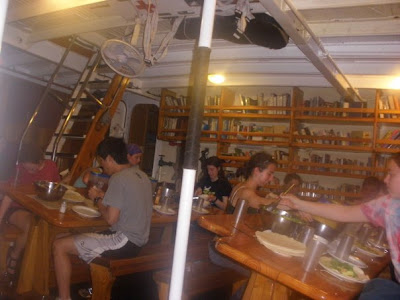 Photo courtesy of Kris Arden
 The Analuisa on exhibit at Mystic Seaport
 Imagine the worst turbulence you've felt on a plane than add a side to side rolling motion and keep that constant for a couple days. And this wasn't even a real storm. These small 10-12 foot waves caused 48 hours of non-stop rolling back and forth that can't quite get captured in a photo or video clip. I learned that any picture of waves in no way shows true depth or height. We were in a tall ship...but the waves often washed over the sides...so anyone who came on deck had to clip it to a line running the length of the deck. [My story about gimbled tables to come soon].
 About a year and a half ago a young man came to the front door of the house in Key West and said that he had hitch-hiked down from upper Minnesota to ask your correspondent a few questions about writing. Arrived that day from Cuba, having to see some good friends off on the train in an hour, and to write some letters in the meantime, your correspondent, both flattered and appalled at the prospect of the questioning, told the young man to come around the next afternoon. He was a tall, very serious young man with very big feet and hands and a porcupine hair-cut...
 We had super snazzy harnesses that most of us chose to wear every possible moment (I mean come on, doing dishes is so much more exciting when you have a harness on). Anyways, the moral of the story is that as it turns out you actually don't clip in until you get to where you were going. Which is at the top of course...
 View from halfway up the foremast...


